Yamaha HS5 Powered Studio Monitor, Pair Review (2026)
Updated September 14, 2026 · Research-based review
Our verdict
The HS5 pair gives podcast editors an accurate, uncolored nearfield reference for judging voice edits and finished mixes, rather than a flattering listen. The 5 inch woofer and 1 inch tweeter reveal problems most headphones hide, but the compact cabinets roll off deep bass and can sound harsh in an untreated room.
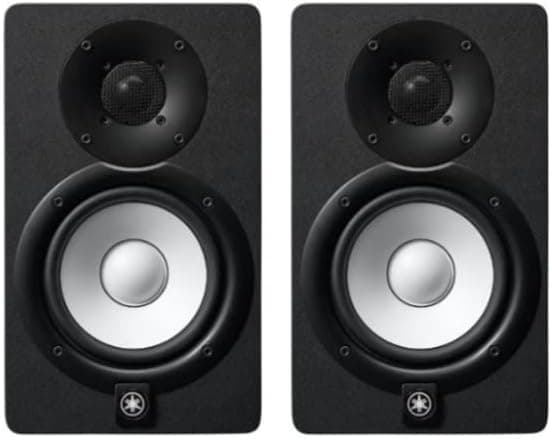
The Yamaha HS5 powered studio monitor pair gives accurate nearfield playback for editing podcasts and checking mixes.
Price range: See on Amazon
What we liked
- + Accurate, uncolored sound reveals problems in voice edits
- + Pair of powered monitors needs only an interface to connect
- + Compact size suits desks in small home studios
Trade-offs
- - Revealing sound can feel harsh in untreated, echoey rooms
- - Limited low bass, so music-heavy shows may want a subwoofer
Who the HS5 pair is built for
The Yamaha HS5 pair is aimed at podcasters who edit or mix on speakers rather than headphones and want a small, affordable pair that tells the truth about a recording instead of flattering it. Because each speaker is self powered, the pair needs only a stereo source, such as an audio interface's monitor outputs, rather than a separate amplifier or receiver, which keeps a desk setup simple. This makes the HS5 a natural fit for a home studio desk where space is limited and the goal is catching editing problems, uneven levels between speakers, or harsh sibilance, before a show goes out. It is a less obvious choice for someone who wants speakers that sound pleasant for casual listening to music, or for anyone needing deep, heavy bass response, since the compact 5 inch woofer is not designed to deliver that on its own.
Drivers, amplification and frequency range explained
Each HS5 is a two way, bass reflex, bi amplified nearfield monitor, meaning the woofer and tweeter each get their own dedicated internal amplifier rather than sharing one, which Yamaha states totals 70 watts per cabinet, split as 45 watts to the 5 inch cone woofer and 25 watts to the 1 inch dome tweeter, crossing over between the two drivers at 2 kHz. The published frequency response is 54 Hz to 30 kHz measured at negative 10 dB, narrowing to 74 Hz to 24 kHz at negative 3 dB, a range that captures the full character of human speech clearly but does not extend into the deepest bass frequencies a larger monitor or subwoofer would reproduce. Inputs accept both balanced XLR and TRS phone jack connections, letting the pair connect directly to most audio interfaces without an adapter.
Setting up and living with the HS5 day to day
Getting a pair running is straightforward: each cabinet needs its own power outlet and a cable from an interface's monitor outputs, with no external amplifier or receiver required since the amplification lives inside each speaker. Placement matters more with monitors like these than with headphones, since the accurate, revealing tonal balance that helps catch editing mistakes can turn harsh or fatiguing if the desk and room have hard, untreated surfaces bouncing sound around, so many owners add basic foam panels or angle the speakers carefully toward the listening position. Because the HS5 lacks deep low end extension, podcasters who also produce music heavy shows or want to judge a subwoofer heavy mix sometimes pair the monitors with Yamaha's matching HS8S subwoofer rather than relying on the HS5 alone. Daily use is otherwise simple, with no ongoing calibration required beyond initial placement.
Trade-offs against closed back headphones and larger monitors
Compared with a closed back headphone such as the Audio-Technica ATH-M50x, the HS5 pair gives a truer sense of stereo width and how a mix will translate to a listener's own speakers, since headphones place sound directly at the ears in a way real world listening never does, but the trade off is that speakers expose editing decisions to anyone else in the room and need a quieter space to use accurately. Against Yamaha's own larger HS8 monitor, the HS5 trades low end extension and maximum output for a smaller footprint and lower cost, which suits a desk bound podcast setup better than a treated control room built around bigger cabinets. Buyers who split time between a quiet home office and noisier shared spaces may find headphones a more practical everyday tool, keeping the HS5 pair for a dedicated final check before publishing.
Verdict and who should choose differently
Carrying our score of 8.6 out of 10, the Yamaha HS5 pair suits podcast editors who want an affordable, self powered reference for the final listen before publishing, valued for an accurate midrange that reveals voice edit problems many headphones and consumer speakers smooth over. It asks for a reasonably quiet room and some care with placement to avoid a harsh sound bouncing off bare desks and walls, and it will not deliver deep bass without an added subwoofer. Podcasters recording in shared or noisy spaces, or who need bass heavy playback for a music focused show, should look at a closed back headphone or a larger monitor paired with a subwoofer instead, saving the HS5 pair for a treated or at least quiet editing spot.
Frequently asked questions
Does the Yamaha HS5 pair need a separate amplifier?
No. Each HS5 cabinet is self powered with its own internal amplifiers for the woofer and tweeter, so the pair only needs a stereo source such as an interface's monitor outputs.
Why do the HS5 monitors sound harsh in some rooms?
Their accurate, uncolored tuning is designed to reveal problems rather than flatter a mix, so untreated rooms with hard, reflective surfaces can make that honesty sound harsh until some basic acoustic treatment is added.
Does the HS5 pair reproduce deep bass?
The 5 inch woofer's response is rated down to roughly 54 Hz, which covers speech clearly but falls short of deep bass; Yamaha offers a matching HS8S subwoofer for shows that need lower extension.
What inputs does the Yamaha HS5 accept?
Each speaker has both a balanced XLR input and a TRS phone jack input, so it connects directly to most audio interfaces or mixers without needing an adapter.
Prices change often, so check the current price and availability on Amazon.
Check price on AmazonPodcast Gear Hub may earn a commission from the link above.