TroyStudio Portable Vocal Booth, Large Foldable Microphone Isolation Shield with Thickened Dense Acoustic Foam Review (2026)
Updated September 14, 2026 · Research-based review
Our verdict
TroyStudio's large foldable vocal booth suits desk podcasters battling an echoey room, wrapping thick acoustic foam around the mic to tame reflections without treating the whole space. It folds flat for storage and travel, though the large shield eats significant desk room and can block a camera's view of your face.
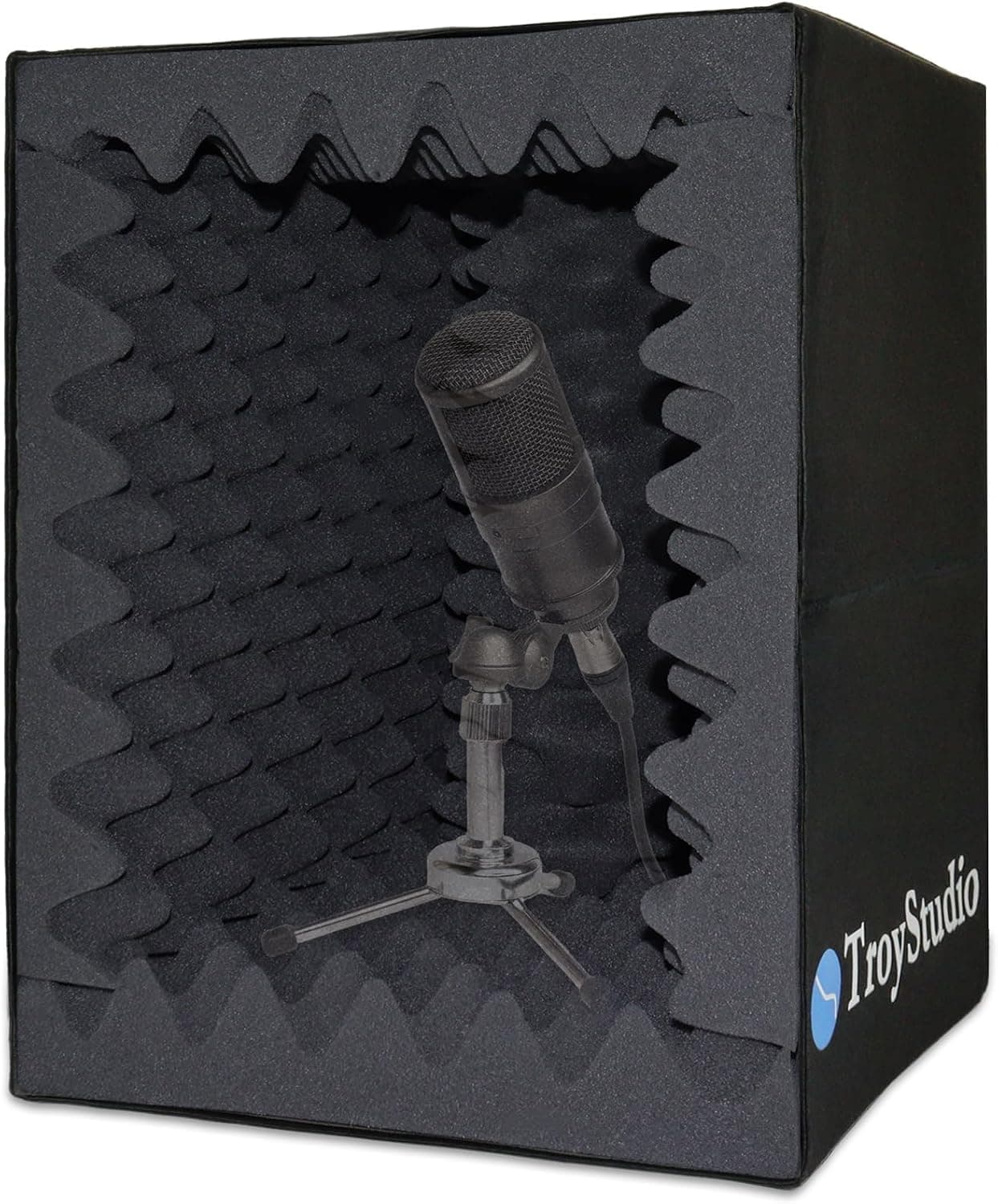
TroyStudio's large foldable portable vocal booth is a mic isolation shield with thickened dense acoustic foam for desk recording.
Price range: See on Amazon
What we liked
- + Thickened dense acoustic foam absorbs more reflections near the mic
- + Large foldable design wraps around the mic to block room echo
- + Portable booth packs down for travel recording sessions
Trade-offs
- - Large shield takes up significant desk or stand space
- - Blocks line of sight to camera on some video podcast setups
Who this vocal booth fits
This portable vocal booth is aimed at podcasters and voice recorders who work from a bedroom, home office, or any untreated room where hard walls and bare surfaces cause echo on every take. Rather than treating an entire room with panels, it wraps a large foldable foam shield directly around the microphone, so it is a good match for anyone recording audio-only episodes at a desk who wants a quick, moveable fix instead of a full acoustic treatment project. It fits both desk-stand and floor-stand setups since it has holes cut for cables and mic stands. It is a weaker match for video podcasters who need to be seen on camera, since the large shield sits close to the face and can intrude into frame or block sightlines to a webcam.
Specs and design in plain English
The booth is a large, multi-panel foldable shield lined on every interior surface with thickened, dense acoustic foam in an egg-crate profile designed to scatter and absorb sound reflections before they bounce back into the mic. Once unfolded and set up around a microphone, the interior recording space measures roughly 12 inches long by 14 inches wide by 16 inches tall, with an exterior footprint of about 16 by 16 by 20 inches. It folds down to about 16 by 16 by 6 inches for storage or travel and weighs around 4 pounds, light enough to move between rooms or pack for an on-location session. Cutouts in the panels let XLR or USB cables pass through without needing to prop the shield open.
Living with a portable vocal booth
Setup involves unfolding the panels around your existing mic stand, whether that is a desktop stand, boom arm, ceiling mount, or floor stand, since the booth is designed to wrap around the microphone rather than replace its stand. It works with vocal dynamic mics, condenser mics, USB mics, and even phones or handheld recorders positioned inside the shield. Because it folds flat, storage between sessions is easy compared to fixed foam panels mounted on a wall, and it travels well for podcasters who record in more than one location. Care is mostly about keeping the foam surfaces free of dust, since acoustic foam can degrade or lose some absorption if compressed or exposed to moisture over time, so storing it folded in a dry space extends its life.
Trade-offs against rival booths
Against the higher-ranked Voicecube Ultra Pro, which uses thicker five-inch walls in the same portable vocal booth guide, this TroyStudio model trades some absorption depth for a lighter, more packable design that is easier to fold and carry between sessions. Its dense foam still meaningfully cuts room reflections near the capsule, which is the main job of any vocal shield, but very live or hard-surfaced rooms may need additional room treatment like corner bass traps alongside it for the cleanest result. Compared to smaller isolation balls or mini booths ranked lower in the same guide, this larger shield covers more of the mic's surroundings, which generally means better isolation at the cost of the desk space it occupies.
Verdict and who should pick something else
This vocal booth earns our score of 8.2 out of 10 as a practical, portable fix for a desk podcaster recording in an untreated room, particularly for audio-only shows where camera visibility is not a concern. It suits anyone who wants a foldable, storable alternative to permanently mounted foam panels. Video podcasters who need their face fully visible on camera, or anyone with very limited desk space, should look at a smaller isolation shield or invest in room treatment like wall panels and corner bass traps instead, since this booth's size is both its main strength for sound and its main drawback for a compact setup.
Frequently asked questions
Does this vocal booth block all room echo?
It significantly reduces reflections near the microphone by surrounding it with dense acoustic foam, though very live rooms may still benefit from additional treatment like wall panels or bass traps.
Will this booth work with a video podcast setup?
It can, but the large shield sits close to the mic and face, so it may intrude on camera framing. It suits audio-only recording better than on-camera shows.
What microphone stands does it work with?
It is designed to wrap around desktop stands, boom arms, ceiling mounts, and floor stands, with cutouts in the panels for cables and stand hardware.
Does it fold down for storage or travel?
Yes. The panels fold flat to about 16 by 16 by 6 inches and the whole unit weighs around 4 pounds, making it reasonably portable between rooms or locations.
Prices change often, so check the current price and availability on Amazon.
Check price on AmazonPodcast Gear Hub may earn a commission from the link above.