RODE RODECaster Pro II All-in-One Production Solution for Podcasting (White) Review (2026)
Updated September 20, 2026 · Research-based review
Our verdict
The white RODECaster Pro II is the same quad-core console as the black original, with four mic inputs and nine assignable channels, now in a bright finish with RGB lighting. It fits multi-host shows wanting a camera-friendly centerpiece, though the light finish shows marks more easily and the price is steep for one or two channels.
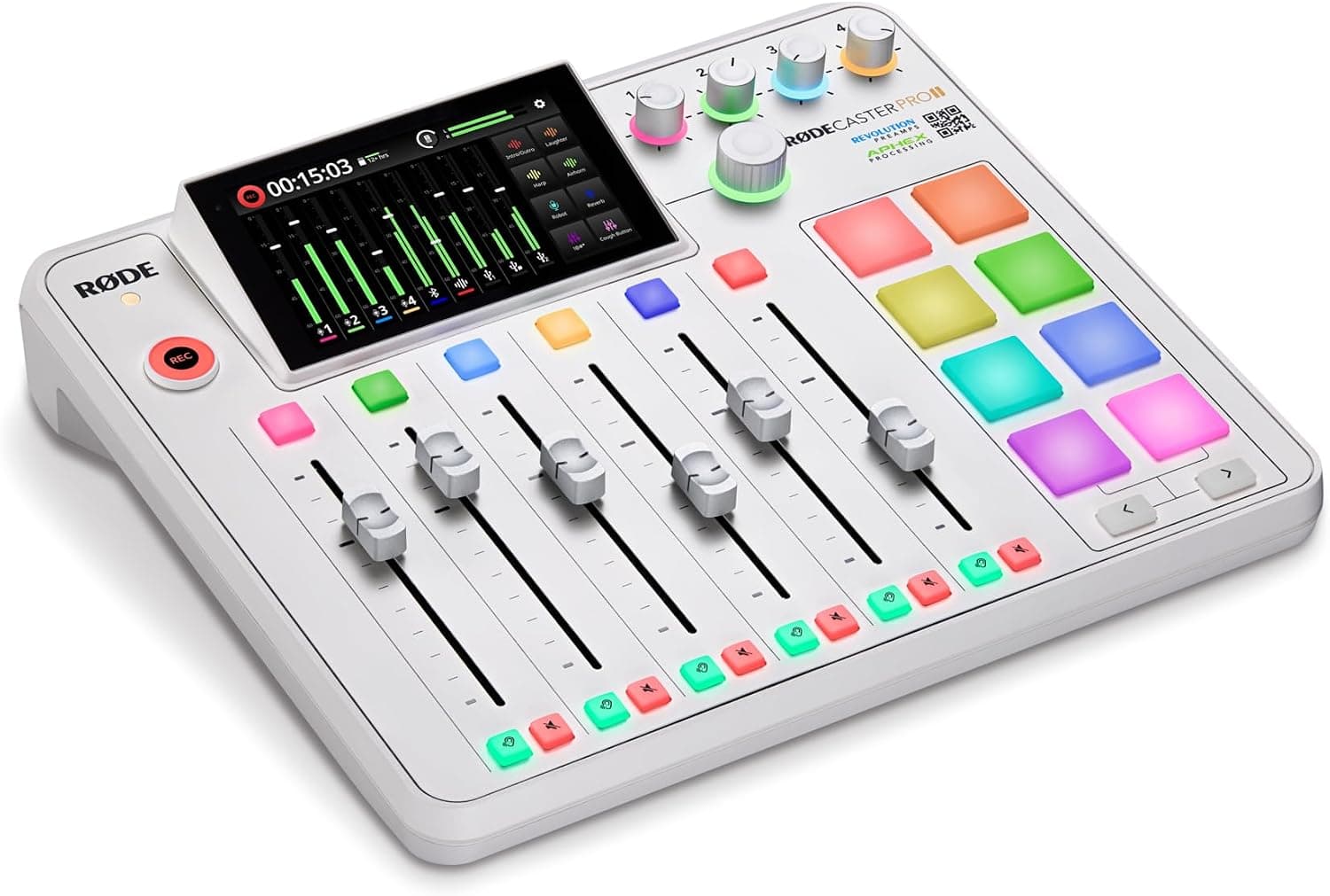
The white RODECaster Pro II is an all-in-one podcast production console, a bright studio centerpiece for multi-host shows.
Price range: See on Amazon
What we liked
- + Four mic inputs and phone connectivity cover hosts plus remote guests
- + Onboard processing gives polished voice without complex plugins
- + White finish stands out as a centerpiece on camera for video shows
Trade-offs
- - High price for creators who only need one or two mic channels
- - Light finish shows dust and marks more than the black version
Who the white RODECaster Pro II fits
This console is built for podcast teams running multi-host shows, especially ones that also record video, where the console itself is visible on camera as part of the set. The white finish specifically fits creators who want the mixer to double as a visual centerpiece rather than blend into the background, since RODE markets it alongside a wider white collection of studio accessories for a coordinated look on camera. Functionally it suits anyone who needs to mix four microphones plus phone-in or remote guests in real time without a separate computer running mixing software, making it a strong fit for shows with co-hosts and regular call-in guests. It is a weaker fit for solo creators who only need one or two microphone channels, since much of its value comes from features built around multi-person production.
Core hardware and channels
The RODECaster Pro II runs on a quad-core audio engine at 24-bit, 48kHz, RODE's standard for broadcast-quality recording, with four Neutrik combo XLR and TRS inputs for connecting microphones or line-level instruments directly. It offers nine total channels, including six physical broadcast-quality faders plus three virtual faders, each of which can be individually assigned to a source, giving more mixing flexibility than a simple four-channel interface. Four headphone outputs let up to four people monitor independently at their own levels, and two balanced quarter-inch line outputs support connecting to external recording or broadcast equipment beyond the console's own inputs.
Preamps, effects and smart pads
RODE's Revolution Preamps are built into each input, described as ultra-low-noise and high-gain, paired with studio-grade APHEX audio processing running in the background. Built-in APHEX effects include Aural Exciter, Big Bottom, and Compellor style dynamics processing, along with reverb, delay, and voice effects like a robot filter, all adjustable without a separate plugin chain on a computer. Eight fully programmable SMART pads sit on the front panel and can be assigned to trigger sound effects, play music beds, activate mixer actions, or send MIDI commands, which suits shows that use stingers, transition sounds, or scripted audio cues during recording or live streaming.
Screen, connectivity and the white-specific extras
A 5.5 inch color touchscreen with haptic feedback sits at an angled position for easy viewing during a session, paired with a rotary encoder for quick navigation between menus and settings without needing to tap through everything on the screen. Connectivity includes Bluetooth for phone call-ins, dual USB-C ports, and both WiFi and Ethernet, along with wireless support for RODE's Series IV transmitters such as Wireless GO II and Wireless ME for cable-free lavalier or handheld mic setups. The white edition specifically adds customizable RGB lighting as a cosmetic feature not present on the standard black unit, positioned by RODE as part of a broader white-finished accessory lineup.
Value and the honest trade-off
As an all-in-one console handling mixing, effects, and multi-guest connectivity without a separate computer, the RODECaster Pro II justifies a premium price for shows that genuinely use its full channel count and feature set. The white finish adds no functional advantage over the black version, its value is purely aesthetic for shows building a coordinated on-camera look. The clearest downsides are practical rather than technical: the price is high for anyone who only needs one or two mic inputs, and a light-colored finish will visibly show dust, fingerprints, and marks over time more readily than the black version does, which matters for a piece of gear handled daily during setup and teardown.
Frequently asked questions
Is the white RODECaster Pro II functionally different from the black version?
No, the core audio engine, channels, preamps, and connectivity are the same. The white edition adds a different finish and customizable RGB lighting as cosmetic extras.
How many microphones can it handle at once?
It has four Neutrik combo XLR and TRS inputs for microphones or instruments, plus additional virtual channels for phone, Bluetooth, and computer audio sources.
Can guests call in remotely?
Yes, it supports Bluetooth connectivity for phone call-ins as well as wireless support for RODE's Series IV transmitters for cable-free lavalier or handheld microphones.
Does the white finish need more upkeep?
A lighter finish generally shows dust, fingerprints, and marks more visibly than a black finish, so it may need more frequent wiping down to keep it looking clean on camera.
Prices change often, so check the current price and availability on Amazon.
Check price on AmazonPodcast Gear Hub may earn a commission from the link above.