Zoom H5 4-Track Portable Recorder with Stereo Mics and 2 XLR/TRS Inputs Review (2026)
Updated September 14, 2026 · Research-based review
Our verdict
The Zoom H5 suits podcasters who record interviews away from a fixed studio and need two proper XLR inputs for real microphones, not just built-in stereo mics. Its interchangeable capsule and rugged design hold up well on location, but recording three or more guests at once means stepping up to a recorder with additional inputs.
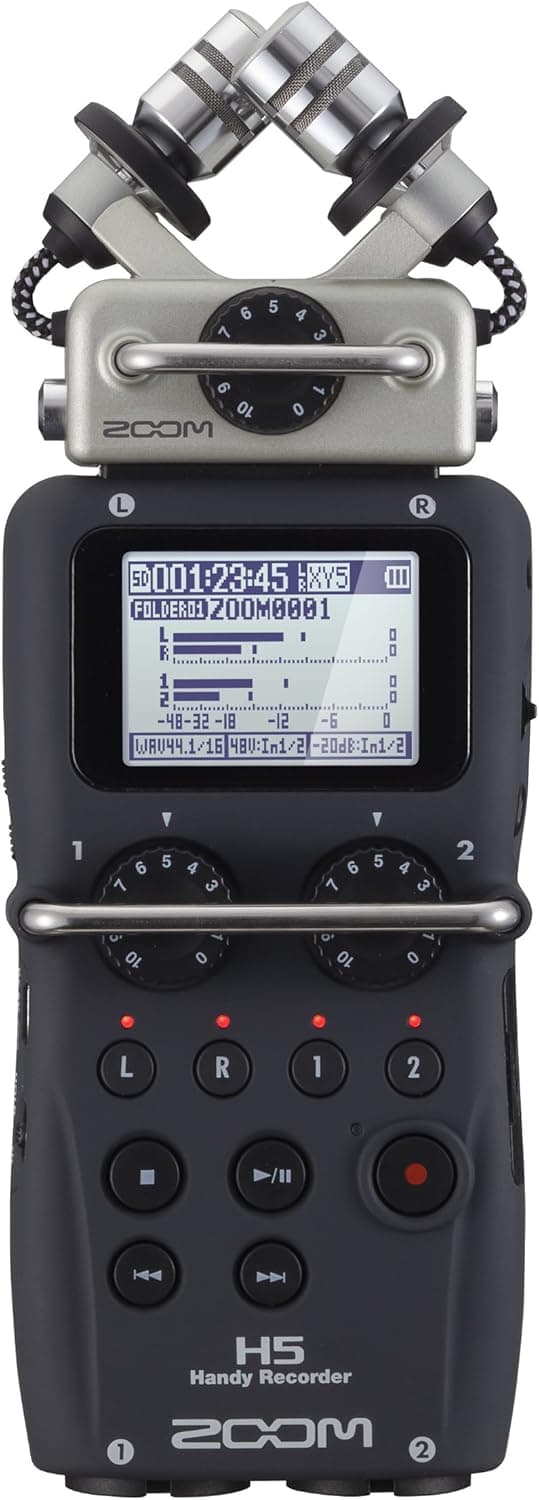
Zoom's H5 4-Track recorder with stereo mics and 2 XLR/TRS inputs is a flexible handheld recorder for podcasts on location.
Price range: See on Amazon
What we liked
- + 2 XLR/TRS inputs record two hosts on proper mics away from a studio
- + Stereo mics capture room ambience or audience reaction alongside voices
- + Protected mic capsule holds up better to bumps than exposed designs
Trade-offs
- - Recording three or more guests requires a model with extra inputs
- - Needs good SD cards and spare batteries for long location days
Who the H5 is built for
The Zoom H5 fits podcasters who regularly record outside a fixed studio, whether that means field interviews, live event coverage or a two-host show recorded at a guest's location, and who want dedicated XLR inputs rather than relying only on a recorder's built-in microphones. Its two XLR/TRS combo inputs with phantom power let a host plug in the same dynamic or condenser microphones they would use at a desk, keeping voice quality consistent between studio and field recordings. It suits solo creators capturing ambience alongside an interview through the built-in stereo capsule as well as duos who need each voice on its own track for cleaner editing. It is a poor match for shows with three or more guests recording simultaneously, since two XLR inputs cap the number of dedicated mic channels available at once.
Key specs and design explained in plain English
The H5's two XLR/TRS combo inputs support switchable phantom power at 12, 24 or 48 volts, a minus 20 dB pad for loud sources, and individual gain knobs per input, giving real control over each microphone's level. The included XYH-5 capsule adds a third and fourth track through a built-in X/Y stereo pair, rated to handle up to 140 dB SPL, and can be swapped for other Zoom capsules to change the pickup pattern entirely. Recording formats cover WAV up to 24-bit and 96 kHz plus MP3, and the H5 can capture all four tracks, two from the capsule and two from the XLR inputs, at the same time. Two AA batteries power roughly ten hours in stereo mode or about five hours in multitrack mode, and the H5 also works as a USB audio interface for direct computer recording.
Living with it day to day
Setting up for an interview means plugging microphones into the two XLR inputs, dialing in gain per channel, and optionally leaving the built-in capsule running to capture room ambience as a separate reference track for editing. The protected mic capsule design shields the built-in stereo microphones from bumps and handling noise better than exposed capsule designs on some competing recorders, a real advantage for run-and-gun field work. Owners should carry spare AA batteries or rechargeables and a couple of good SD cards for any full day of location recording, since battery life drops noticeably once both XLR inputs and the capsule are active in multitrack mode. The interchangeable capsule system also means the H5 can be reconfigured for shotgun or mid-side recording later without buying a whole new recorder.
Honest trade-offs against the TASCAM DR-05XP and Zoom H4essential
Against the TASCAM DR-05XP, which has no XLR inputs at all, the H5 is the clear choice for anyone plugging in dedicated podcast microphones on location rather than relying on built-in mics that pick up the whole room. Compared with Zoom's own H4essential, which adds 32-bit float recording to remove the need for careful gain staging, the H5's more traditional 24-bit workflow demands a bit more attention to input levels but remains a proven, widely supported option with a large ecosystem of swappable capsules. For a three-or-more-guest round table, none of these two-input recorders are ideal, and a model with additional XLR inputs or a dedicated multi-input mixer becomes the more sensible tool.
Verdict and who should choose differently
With our score of 8.4 out of 10, the H5 remains a dependable choice for podcasters who need real XLR flexibility in a portable, battery-powered recorder, backed by a protected capsule design that survives regular field use. It fits two-person interview shows, location reporting and hybrid setups that also use it as a USB interface at the desk. Anyone recording three or more simultaneous mic sources should look at a recorder with more inputs, and anyone who never plans to use external microphones may find the simpler, XLR-free TASCAM DR-05XP a lighter, cheaper alternative for solo field notes.
Frequently asked questions
Can the Zoom H5 power condenser microphones?
Yes, both XLR/TRS combo inputs offer switchable phantom power at 12, 24 or 48 volts, so it can run condenser mics as well as dynamic ones.
How many people can the Zoom H5 record at once?
It has two XLR inputs plus a built-in stereo capsule, so it suits solo or two-host recording well, but three or more separate mic sources exceed its dedicated input count.
Can the H5 be used as a USB microphone for a computer?
Yes, it functions as a USB audio interface, letting it plug directly into a computer for recording or as a live input device.
Is the built-in capsule on the H5 replaceable?
Yes, the included XYH-5 X/Y capsule can be swapped for other Zoom capsules, such as shotgun or mid-side options, to change its pickup pattern.
Prices change often, so check the current price and availability on Amazon.
Check price on AmazonPodcast Gear Hub may earn a commission from the link above.