Shure SM57 Dynamic Instrument Microphone, Wired Cardioid XLR Review (2026)
Updated September 14, 2026 · Research-based review
Our verdict
The Shure SM57 is a rugged cardioid dynamic mic built for instruments that also works as a budget voice mic thanks to its tight pattern and near-legendary durability. It suits podcasters who want a mic they buy once and keep for decades, though its instrument-tuned sound can read thinner on voice and it has no built-in pop filter.
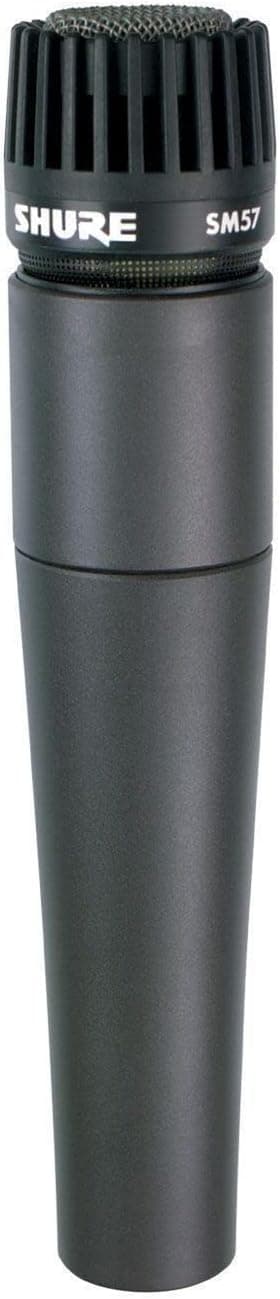
The Shure SM57 is a wired cardioid dynamic instrument mic, a rugged XLR staple that also works for budget voice recording.
Price range: See on Amazon
What we liked
- + Near-legendary durability makes it a mic you buy once and keep for decades
- + Compact head is easy to aim at a mouth or instrument in tight desk setups
- + Tight cardioid pattern helps isolate each person on a shared podcast table
Trade-offs
- - Tuned for instruments, so voices can sound thinner than on vocal-focused mics
- - No built-in pop protection, so plosives need a foam windscreen or pop filter
Who the SM57 fits
The SM57 is primarily an instrument microphone, built for miking guitar amps, snare drums, and horns on stage and in the studio, but its compact head, tight cardioid pattern, and legendary toughness also make it a workable budget option for podcasters on a tight table. Because its pattern isolates the mouth in front of it while rejecting sound from the sides, it suits a shared podcast table where each host needs their own mic without picking up too much crosstalk from the person next to them. It particularly fits podcasters who already own an SM57 for music recording and want to reuse it for voice work rather than buying a second mic. It is a weaker fit for anyone whose top priority is the richest, warmest voice sound, since the SM57's frequency shaping favors instruments over spoken word.
Specs and design in plain English
Shure rates the SM57's frequency response from 40 Hz to 15,000 Hz with a cardioid, or unidirectional, pickup pattern that isolates the primary sound source and minimizes background noise from other directions. It connects over a standard three-pin XLR output and weighs 284 grams. The mic is built for rugged performance, described by Shure as able to withstand impacts including a hit from a kick drum pedal or a flying drumstick, which is the same toughness that lets it survive years of touring and studio use without failing. A pneumatic shock-mount system inside the housing reduces handling noise, and the package includes an A25D swivel stand adapter and a storage bag, though unlike the SM58 it has no built-in spherical pop filter since it is designed primarily for instruments rather than close vocal work.
Living with the SM57
Setup is simple: mount it on a stand or boom arm using the included swivel adapter, connect your own XLR cable, and run it into a preamp or interface with enough gain, since it is a passive dynamic mic with no batteries or phantom power required. For voice use, positioning matters more than with a dedicated broadcast mic, since without a built-in pop filter, plosives on words starting with hard consonants will need either careful mic placement slightly off-axis or an external foam or gooseneck pop filter added separately. Care is minimal thanks to the rugged steel construction, a wipe with a dry cloth keeps the mesh clean, and the mic tolerates being packed in a gig bag or dropped in a case between sessions far better than more delicate condenser microphones.
Trade-offs against rival microphones
Against the Shure SM7B and Rode PodMic USB, both ranked well ahead of the SM57 in the same dynamic microphone guide, the SM57's instrument-first tuning is its clearest limitation for voice work, since those broadcast-focused mics shape frequencies specifically for spoken word and include built-in pop protection the SM57 lacks. Even against its close sibling the SM58, which is tuned for vocals and includes a built-in pop filter, the SM57 trails slightly for voice use despite sharing similar durability and connector type. What the SM57 offers instead is exceptional versatility for anyone who also records instruments, since one mic can reasonably cover both a guitar cab and a podcast table, a trade-off worth making only if that dual use actually matters to you.
Verdict and who should pick something else
The SM57 earns our score of 7.7 out of 10, held back mainly by features and specs since it was never designed as a voice-first microphone, while still scoring a perfect mark for build quality that reflects its reputation as one of the toughest mics ever made. It is a reasonable budget pick for podcasters who already own one for instrument recording or who prioritize durability above all else on a tight table setup. Anyone starting from scratch who wants the best possible voice sound for podcasting specifically should look at a broadcast-tuned dynamic mic like the SM58 or SM7B instead, since both include built-in pop protection and frequency shaping better suited to spoken word.
Frequently asked questions
Is the Shure SM57 good for podcasting?
It can work, especially at a shared table thanks to its tight cardioid pattern and durability, but it is tuned for instruments, so a broadcast-style mic like the SM58 or SM7B will generally sound better for voice.
Does the SM57 have a built-in pop filter?
No. Unlike the SM58, the SM57 has no built-in spherical pop filter, so voice recording benefits from careful off-axis mic placement or an added external pop filter.
Does the SM57 need phantom power?
No. It is a passive dynamic microphone that needs no batteries or phantom power, just a preamp or interface with enough gain to drive it.
What comes included with the SM57?
It ships with an A25D swivel stand adapter and a storage bag, though it does not include an XLR cable, so you will need to buy one separately.
Prices change often, so check the current price and availability on Amazon.
Check price on AmazonPodcast Gear Hub may earn a commission from the link above.