AKG K240 Studio Semi-Open Professional Studio Headphones Review (2026)
Updated September 14, 2026 · Research-based review
Our verdict
The AKG K240 Studio suits podcasters editing and mixing at a desk who prefer a natural, less fatiguing semi-open sound over closed-back isolation. Its lightweight self-adjusting headband stays comfortable for long editing sessions, but the open design leaks sound, making it a poor choice near a live microphone during recording.
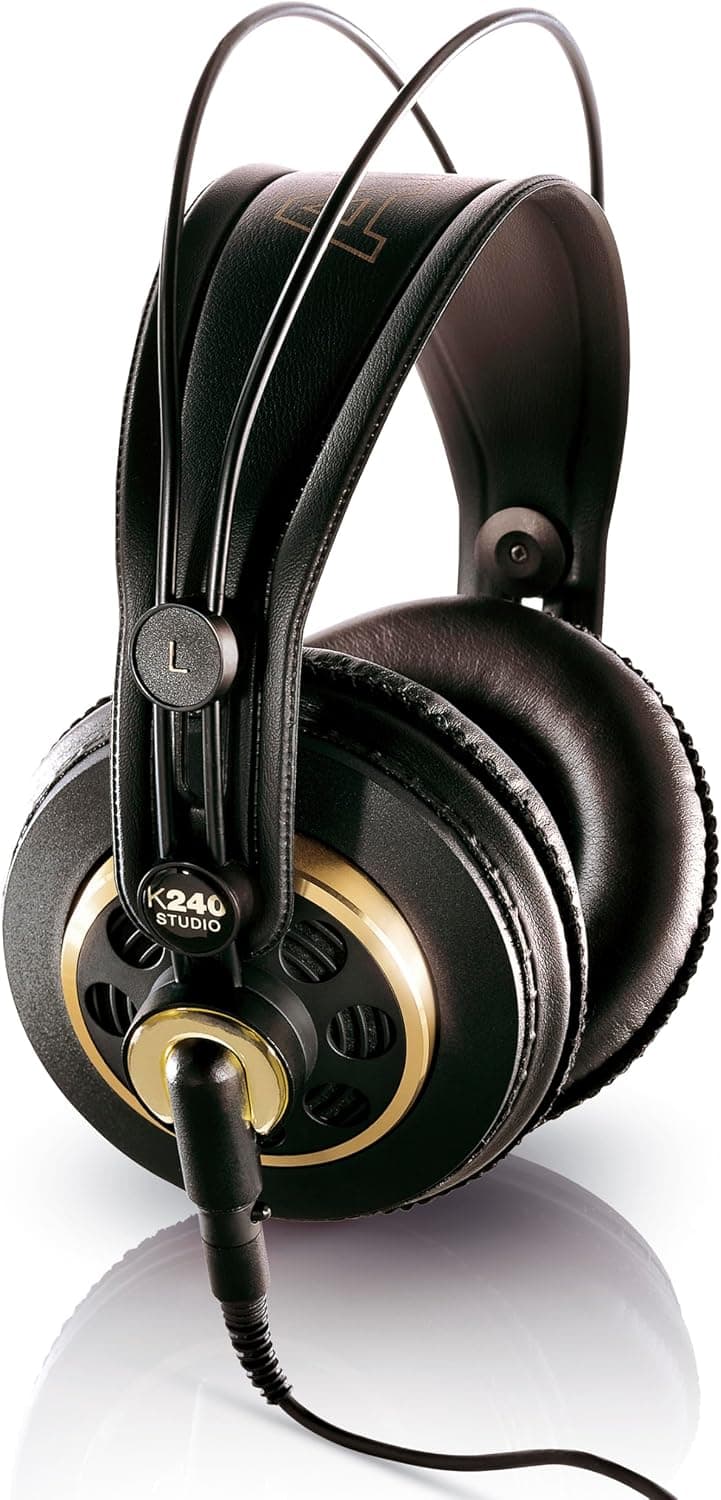
The AKG K240 Studio are semi-open professional studio headphones, a comfortable classic for editing and mixing.
Price range: See on Amazon
What we liked
- + Semi-open design sounds more natural and less fatiguing than closed cups
- + Lightweight self-adjusting headband stays comfortable for hours
- + Replaceable cable is easy to swap if it gets damaged
Trade-offs
- - Semi-open cups leak sound, so they can bleed into nearby mics
- - Less isolation makes them poor for noisy recording environments
Who the K240 Studio is built for
The AKG K240 Studio fits podcasters and editors who spend long stretches mixing and reviewing episodes at a desk and want a comfortable, natural-sounding headphone for that work rather than one built for isolation during a live recording. Its semi-open design trades some noise blocking for a more relaxed, less fatiguing listening experience over multi-hour editing sessions, which suits post-production work more than tracking a guest in the same room. Podcasters who edit in a quiet home office, where sound leaking in or out is not a concern, get the most benefit from this classic design. It is a poor fit for anyone recording with an open microphone nearby, since the semi-open cups leak enough sound to bleed into a sensitive mic capsule during a live session.
Key specs and design explained in plain English
The K240 Studio uses 30 millimeter XXL transducers with AKG's patented Varimotion diaphragm design, aimed at a wide dynamic range and increased sensitivity, paired with an impedance of 55 ohms that makes the headphones usable straight from a laptop or basic interface without a dedicated amplifier. AKG specifies a frequency bandwidth of 15 to 25,000 Hz and a sensitivity of 104 dB SPL per volt, along with a maximum input power of 200 milliwatts. The semi-open earcups are intentionally not fully sealed, letting some sound pass through the housing, which is what gives them their more natural, open soundstage compared with a closed-back design. A detachable 3 meter cable with a mini XLR connector on the headphone side terminates in a 3.5 millimeter stereo plug, with a screw-on 6.3 millimeter adapter included for larger jacks.
Living with it day to day
The self-adjusting headband is a signature K240 Studio feature, spreading weight across the top of the head without a separate sizing adjustment, and the overall build stays lightweight enough for genuinely long editing sessions without the ear fatigue some larger closed-back headphones cause. Because the cable is detachable, a worn or damaged cable can be replaced rather than requiring a whole new headphone, extending its usable life at a desk. Owners doing pure editing and mixing work, away from a live microphone, tend to appreciate the semi-open sound the most, since there is no isolation trade-off to worry about when nothing else is picking up leaked audio. For anyone who also records interviews at the same desk, it is worth switching to closed-back headphones during tracking and saving the K240 Studio for the edit pass afterward.
Honest trade-offs against the Audio-Technica ATH-M40x and Sennheiser HD 280 Pro
Against the closed-back Audio-Technica ATH-M40x, the K240 Studio trades isolation for a more natural, open soundstage that many editors find less fatiguing over long sessions, though the M40x is the safer pick for anyone recording near a live mic since it will not leak sound the way a semi-open design does. Compared with the Sennheiser HD 280 Pro, built specifically for strong isolation in a compact, lightweight shell, the K240 Studio sits at the opposite end of the spectrum, prioritizing comfort and tonal accuracy for editing over noise blocking for live monitoring. Podcasters who only edit, and never record with the headphones on near an open mic, get real comfort benefits from the K240 Studio that closed-back options cannot match.
Verdict and who should choose differently
With our score of 7.8 out of 10, the K240 Studio remains a comfortable, affordable classic for podcasters focused on editing and mixing rather than live tracking, offering solid value alongside its lightweight, long-session comfort. It fits a home studio desk workflow where isolation is not a concern and a natural, semi-open sound is preferred for detailed listening. Anyone who records with an open microphone nearby, works in a noisy space, or needs strong isolation while monitoring should choose a closed-back headphone such as the Sennheiser HD 280 Pro or Audio-Technica ATH-M40x instead, since the K240 Studio's open design works against those specific needs.
Frequently asked questions
Do the AKG K240 Studio headphones leak sound during recording?
Yes, their semi-open design lets sound pass through the earcups, so they can bleed into a nearby open microphone and are better suited to editing away from a live mic.
Do the K240 Studio headphones need a headphone amplifier?
Not necessarily. Their 55 ohm impedance and 104 dB SPL per volt sensitivity make them usable directly from a laptop or basic interface, though an amp can still help drive them louder.
Is the cable on the AKG K240 Studio replaceable?
Yes, it uses a detachable 3 meter cable with a mini XLR connector at the headphone end, so a damaged cable can be swapped rather than replacing the whole headphone.
Are the K240 Studio headphones comfortable for long editing sessions?
Yes, the self-adjusting headband and lightweight build are designed for extended wear, which is a major part of their appeal for editing and mixing work.
Prices change often, so check the current price and availability on Amazon.
Check price on AmazonPodcast Gear Hub may earn a commission from the link above.