Sony MDR7506 Professional Large Diaphragm Headphone Review (2026)
Updated September 14, 2026 · Research-based review
Our verdict
The Sony MDR7506 suits podcasters and editors who want an affordable, well-proven monitoring headphone that reveals clicks, pops and background noise other headphones hide. Its strength is detailed, bright midrange and a lightweight folding build. The trade-off is a fixed coiled cable that cannot be replaced if it fails.
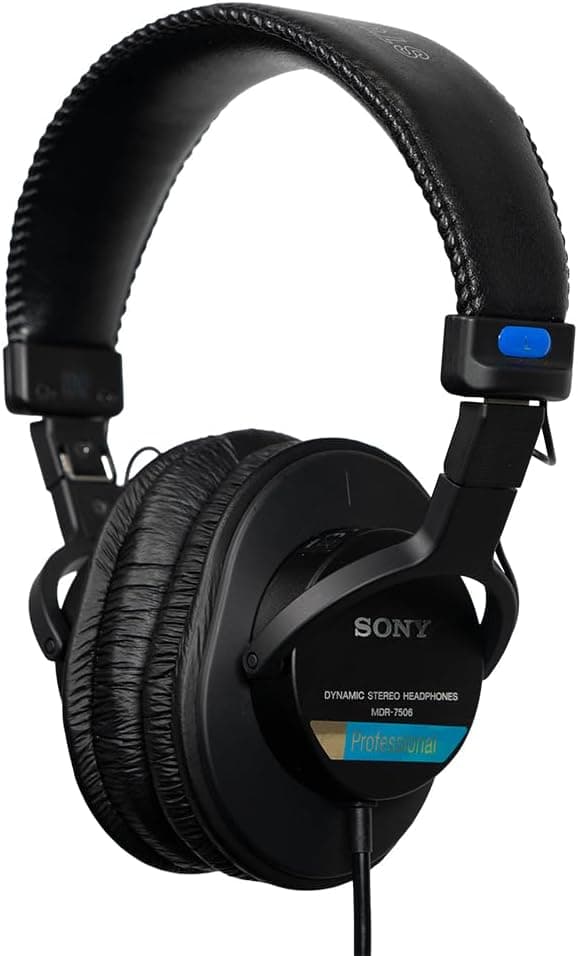
The Sony MDR7506 is a professional large-diaphragm headphone, a long-standing broadcast and studio standard for monitoring voice.
Price range: See on Amazon
What we liked
- + Bright, detailed sound makes clicks, pops and noise easy to hear
- + Closed design limits bleed into mics when hosts wear them on air
- + Lightweight folding build is comfortable and easy to pack
Trade-offs
- - Coiled cable is fixed, so damage means repairing the whole headphone
- - Earpads tend to flake over time and need replacement
Who these headphones fit
The MDR7506 has been a studio and broadcast standard since the early 1990s, and it remains a go-to pick for podcasters editing their own episodes or monitoring live because its bright, detailed sound makes it easy to catch mouth clicks, plosives and background hum that a warmer consumer headphone might mask. Editors doing detailed cleanup work, hosts who want to hear exactly how their voice sounds while recording, and anyone on a budget who still wants a genuinely professional-grade monitoring tool are the core audience. Its closed-back design also limits sound leaking out into a nearby open microphone, making it workable for recording sessions as well as editing. Anyone wanting a warm, bass-heavy consumer sound for casual listening will likely find the MDR7506's more neutral, treble-forward tuning less to their taste outside of monitoring work.
Specs and design in plain English
Amazon's own listing and independent measurements put the frequency response at roughly 10 Hz to 20,000 Hz using 40mm drivers, with impedance figures reported differently across sources, generally in the low 60 ohm range, and a fixed, non-removable coiled cable that stretches to about 2.5 meters, or roughly 9.8 feet, terminated in gold-plated connectors with an oxygen-free copper cord for a cleaner signal path. The closed-back, circumaural design seals around the ear to block outside sound and keep the headphone's own output from leaking into a nearby mic. The earcups fold flat, and the headband collapses down, making the MDR7506 genuinely portable for a headphone with a coiled cable, which matters for anyone who records on location as well as at a fixed desk.
Living with it day to day
Reviewers consistently point to excellent midrange reproduction, particularly in the 500 Hz to 2 kHz range that covers most of human speech, as the reason the MDR7506 has stayed relevant for podcast and broadcast monitoring for decades despite an otherwise unchanged design. The lightweight build makes it comfortable for long editing sessions, and the folding hinge means it travels well in a bag between a home studio and a remote recording location. Setup is plug and play with the standard 3.5mm jack, and a screw-on quarter-inch adapter is typically included for mixers and interfaces that use the larger connector. Because the sound is tuned for accuracy rather than enjoyment, some new users find it a little harsh or bright at first compared with consumer headphones, though most editors come to rely on exactly that honesty.
Trade-offs and how it compares
The single most repeated complaint across independent reviews is the fixed coiled cable, since Sony has kept the non-detachable design even through recent production updates, meaning any cable fault requires sending the whole headphone in rather than swapping a cord. Against the Sennheiser HD 280 Pro, both aim at the same closed-back monitoring niche, but reviewers generally describe the MDR7506 as lighter and less clamping, while the HD 280 Pro edges it slightly on outright isolation from outside noise. Against the newer Audio-Technica ATH-M50x, the MDR7506 is the more budget-friendly, no-frills option, trading a detachable cable and a slightly more mainstream tuning for a lower price and a decades-long track record in broadcast use.
Verdict and who should look elsewhere
Scoring 8.3 out of 10 here, the MDR7506 earns its reputation as a dependable, affordable monitoring headphone that has outlasted most of its original competition for good reason, honest midrange, a comfortable folding build, and a low price relative to what it delivers. It suits podcasters editing their own shows and anyone who wants proven studio credibility without paying for a detachable cable or extra accessories. Buyers who record or travel frequently and want a cable that can be replaced if damaged, or who prefer a warmer, less analytical sound signature for casual listening, should look at a headphone with a detachable cord instead.
Frequently asked questions
Can the Sony MDR7506 cable be replaced?
No. It uses a fixed, non-detachable coiled cable, so a damaged cable means the headphone itself needs to be repaired rather than the cord swapped.
Are the MDR7506 headphones good for podcast editing?
Yes. Reviewers highlight their detailed midrange reproduction as especially useful for catching clicks, pops and background noise while editing.
Do the MDR7506 headphones fold up for travel?
Yes. The earcups fold flat and the headband collapses, making them reasonably portable despite the fixed coiled cable.
Is an adapter included for larger headphone jacks?
A quarter-inch screw-on adapter is typically included alongside the 3.5mm plug for use with mixers and audio interfaces.
Prices change often, so check the current price and availability on Amazon.
Check price on AmazonPodcast Gear Hub may earn a commission from the link above.