Audio-Technica AT2020 Cardioid Condenser Studio XLR Microphone Review (2026)
Updated September 14, 2026 · Research-based review
Our verdict
Best for a podcaster building a first proper XLR setup who wants a detailed, affordable condenser sound rather than a starter USB mic. The AT2020 rewards a quiet, treated room, but it ships without a shock mount or pop filter, so those become required add-on purchases.
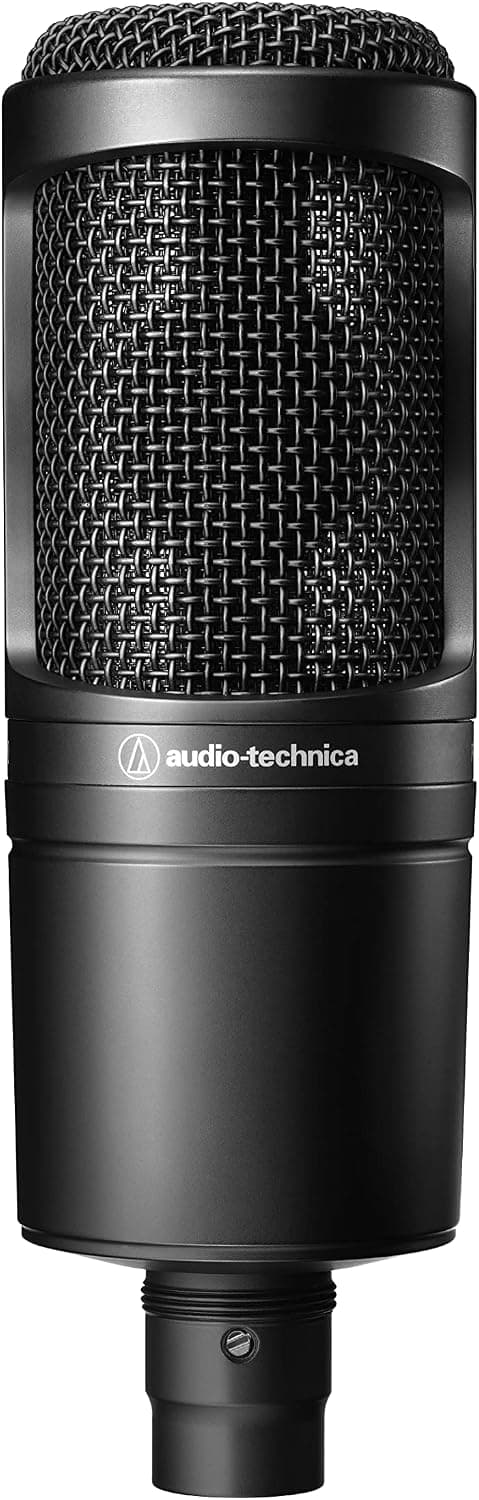
The Audio-Technica AT2020 is a cardioid condenser XLR mic, a long-standing affordable studio choice for voice and home recording.
Price range: See on Amazon
What we liked
- + Clear, detailed condenser sound flatters spoken voice in a treated room
- + Audio-Technica build quality is solid for the price and lasts for years
- + Standard XLR output pairs with nearly any interface that supplies phantom power
Trade-offs
- - Sensitive capsule picks up room reflections, so treatment or a shield helps a lot
- - No shock mount or pop filter included, so budget for those accessories
Who the AT2020 is for
The AT2020 is Audio-Technica's long-running cardioid condenser microphone, built around a custom low-mass diaphragm and sold as an XLR mic rather than a USB one, so it requires an audio interface or mixer that supplies 48V phantom power. That makes it a fit for a podcaster or voice-over creator who has already decided to build around an interface, perhaps alongside a future second mic for a co-host, rather than someone who just wants to plug a single mic straight into a laptop. Its cardioid pickup pattern rejects sound from the rear while capturing detail from the front, which suits a solo host recording close to the capsule in a reasonably quiet room. Streamers who need instant plug-and-play simplicity, or anyone recording in an untreated, echoey space, are less well served by a sensitive condenser like this one.
The core specs that define its sound
Audio-Technica lists a linear frequency response across the full 20Hz to 20kHz audible range, which is what gives the AT2020 its reputation for a clear, extended, and reasonably neutral voice sound rather than a heavily colored or bass-boosted one. The cardioid polar pattern focuses pickup on whatever is directly in front of the capsule while reducing sound from the sides and rear, helping a bit with background noise as long as the room itself is not too reflective. It handles high sound pressure levels with a wide dynamic range, so it does not distort easily on loud passages, and it connects over standard XLR, requiring 48V phantom power from whatever interface or mixer it is plugged into. In the box, Audio-Technica includes a stand mount that adapts between 5/8 inch-27 and 3/8 inch-16 threaded stands, along with a soft protective pouch for storage.
Setting it up in a real recording space
Because the AT2020 is a sensitive condenser, the room around it matters as much as the mic itself, so most owners pair it with at least some basic foam treatment on the wall behind the mic and a boom arm or stand rather than a stiff desk mount, which helps avoid transmitting desk knocks and vibration straight into the capsule. The mic does not include a shock mount or pop filter, both of which are near-essential accessories for close-mic'd voice work, since plosive sounds from letters like P and B can overload the capsule without one. Setup is otherwise straightforward: connect via XLR to an interface with phantom power, set gain conservatively since the mic is fairly sensitive, and position it close enough to benefit from proximity effect without picking up excess breath noise.
How it stacks up against other studio mics
Against a dynamic broadcast mic such as the Shure SM7B, the AT2020 trades some of that mic's built-in noise rejection for a brighter, more detailed condenser character and a notably lower price, which suits a treated room better than a noisy one. Compared with a large-diaphragm condenser like the Rode NT1-A, the AT2020 sits at a similar price tier with a broadly comparable use case, so the choice between them often comes down to personal taste in tonal character and available accessories rather than a clear technical gap. Buyers coming from a USB dynamic mic with a mute button and RGB lighting will need to budget for an interface, cables, a shock mount, and a pop filter to get the AT2020 fully usable, which raises the real total cost beyond the mic's own price.
Verdict and who should pick something else
For a podcaster ready to commit to an XLR setup in a reasonably quiet room, the AT2020 earns our score of 8.0 out of 10 as a well-regarded, affordable way into condenser sound quality. Buyers who record in an untreated space with noticeable room noise, traffic, or echo will likely get more consistent results from a dynamic mic that rejects more of that background sound. Anyone who wants to be recording within minutes of unboxing, without buying an interface, shock mount, and pop filter separately, should look at a USB mic instead.
Frequently asked questions
Does the AT2020 need phantom power?
Yes. It is an XLR condenser microphone that requires 48V phantom power from an audio interface or mixer to operate, so it will not work when plugged directly into a device without that supply.
Does the AT2020 come with a pop filter or shock mount?
No. The box includes only a threaded stand mount and a soft storage pouch, so a shock mount and pop filter need to be purchased separately for typical podcast or voice-over use.
Is the AT2020 good for a noisy or untreated room?
It is a sensitive cardioid condenser, so it picks up more room reflections and background noise than a dynamic mic. It performs best in a quiet space with at least some basic foam or furniture to absorb echo.
Prices change often, so check the current price and availability on Amazon.
Check price on AmazonPodcast Gear Hub may earn a commission from the link above.