Zoom H1n Portable Recorder with Onboard Stereo Microphones Review (2026)
Updated September 14, 2026 · Research-based review
Our verdict
Best as a pocket-sized backup recorder or a first handheld for grabbing interviews and voice notes on the go. Its onboard stereo mics are genuinely useful, but the lack of any XLR input means it cannot replace a dedicated podcast mic setup.
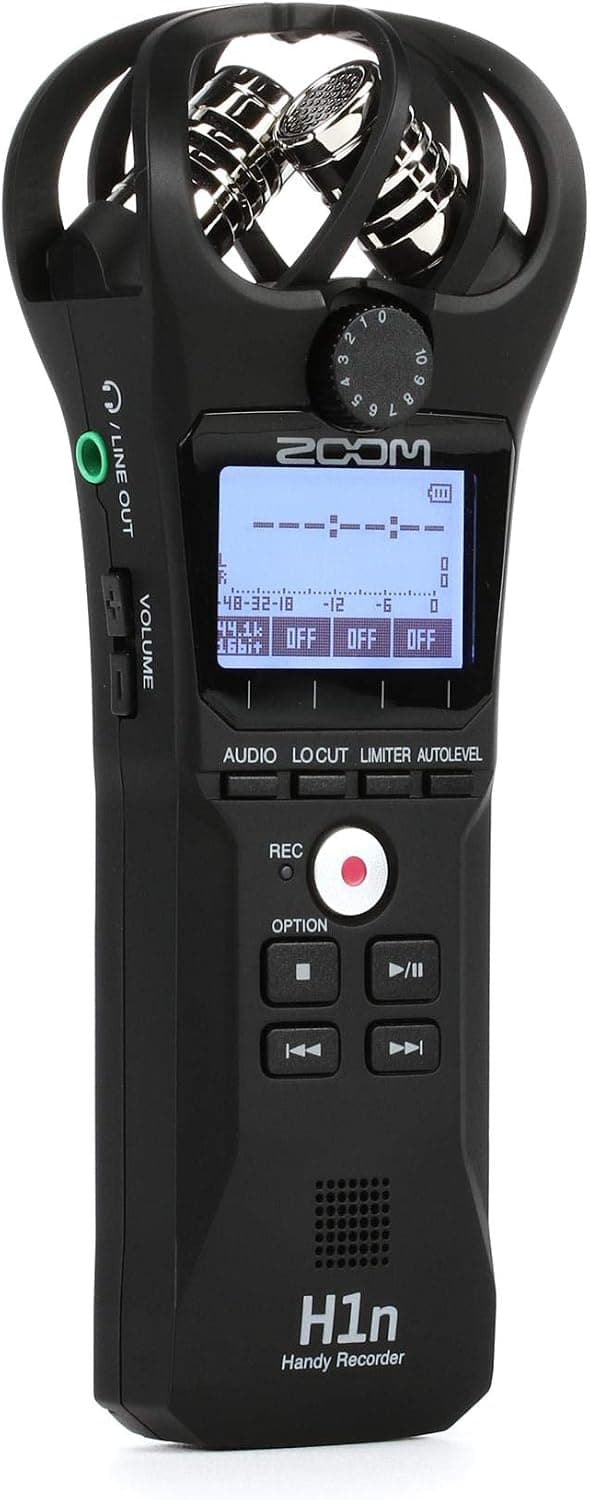
The Zoom H1n is a portable recorder with onboard stereo mics, a small, simple recorder for interviews and on-the-go voice notes.
Price range: See on Amazon
What we liked
- + Onboard stereo mics capture interviews and ambience instantly
- + Very compact size slips into a pocket or small camera bag
- + Simple controls make it a friendly first handheld recorder
Trade-offs
- - No XLR inputs, so it cannot record separate podcast mics
- - Lightweight plastic body is more fragile than larger Zoom recorders
Who the H1n is for
The Zoom H1n is a small, simple handheld recorder built around a pair of onboard XY stereo condenser microphones, aimed at anyone who needs to capture sound quickly without carrying a bag of separate mics and cables. That makes it a fit for a podcaster gathering ambience or a quick hallway interview, a content creator recording voice memos and ideas on the move, or a beginner who wants a first standalone recorder before investing in a full XLR setup. Its compact size and simple button layout also suit less technical users, students, or journalists who need reliable audio without a learning curve. Anyone planning to record a full multi-host podcast episode, or who needs to plug in a dedicated podcast microphone, will run into the H1n's biggest limitation immediately, since it has no XLR or TRS inputs at all.
What the compact stereo design offers
The built-in microphones use a 90 degree XY stereo configuration, an unidirectional condenser design that captures a natural sense of space and direction, useful for recording interviews, ambience, or live moments where a wide, realistic stereo image matters more than isolating a single voice. Zoom rates the onboard mics to handle up to 120dB SPL without distorting, giving some headroom for louder environments such as a live event or busy street interview. Recording supports up to 24-bit depth at sample rates of 44.1, 48, or 96kHz, saved as WAV or MP3 files onto a microSD or microSDHC card up to 32GB, which keeps file sizes and card costs reasonable for a device this size.
Living with it day to day
At just 1.9 by 5.4 by 1.2 inches and about 60 grams without batteries, the H1n is genuinely pocketable, running on two AAA batteries for roughly 10 hours of continuous recording, which makes it easy to grab on the way out the door for an unplanned interview or field recording. It includes a 1/8 inch headphone jack with its own volume control for monitoring, a matching input jack for an external microphone when the onboard mics are not the right tool, and a Micro USB port that doubles as a basic audio interface at up to 16-bit, 48kHz when connected to a computer. A small monochrome LCD display and physical buttons keep operation simple, though the plastic body feels noticeably lighter and less rugged than Zoom's larger recorders.
How it compares with larger Zoom recorders
Against the Zoom H5, which adds two XLR and TRS combo inputs with phantom power on top of its own onboard stereo mics, the H1n gives up the ability to record a dedicated podcast microphone entirely, trading that flexibility for a much smaller and cheaper package. Compared with the newer H4essential and its 32-bit float recording, the H1n's more basic 24-bit format offers less protection against clipping if levels are set incorrectly, which matters more for unpredictable live recording than for controlled voice notes. For a buyer who already owns XLR podcast mics and just needs a lightweight field recorder to capture ambience or backup interview audio, the H1n's small size becomes its main selling point rather than a limitation.
Verdict and who should pick something else
As a compact, affordable way to capture interviews, ambience, or voice notes without carrying extra gear, the H1n earns our score of 7.2 out of 10, with its clear weak point being the total absence of XLR inputs for anyone who needs to plug in a dedicated podcast mic. Buyers planning a proper multi-host podcast setup, or anyone who wants one device to grow into a full studio rig, should look at a Zoom H4 or H5 series recorder instead. Anyone who mainly records in loud, chaotic environments may also want a recorder with a sturdier body than this lightweight plastic shell.
Frequently asked questions
Does the Zoom H1n have XLR inputs for a podcast mic?
No. It relies entirely on its built-in onboard stereo microphones and has no XLR or TRS inputs, so a separate dedicated podcast microphone cannot be connected to it directly.
How long does the H1n record on a set of batteries?
It runs on 2 AAA batteries for approximately 10 hours of continuous recording, according to Zoom's published specifications.
Can the H1n be used as a USB microphone for a computer?
Yes, to a limited extent. Its Micro USB port can work as a basic audio interface at up to 16-bit, 48kHz when connected to a computer, in addition to recording independently onto a microSD card.
Prices change often, so check the current price and availability on Amazon.
Check price on AmazonPodcast Gear Hub may earn a commission from the link above.