HyperX QuadCast USB Condenser Gaming Microphone with Anti-Vibration Shock Mount Review (2026)
Updated September 20, 2026 · Research-based review
Our verdict
HyperX's QuadCast is a USB condenser with a built-in anti-vibration shock mount and four polar patterns, making it a flexible plug-and-play mic for solo podcasting or the occasional in-person guest. It sounds good for the price, but like most condensers it needs a treated space and close mic technique to avoid picking up room noise.
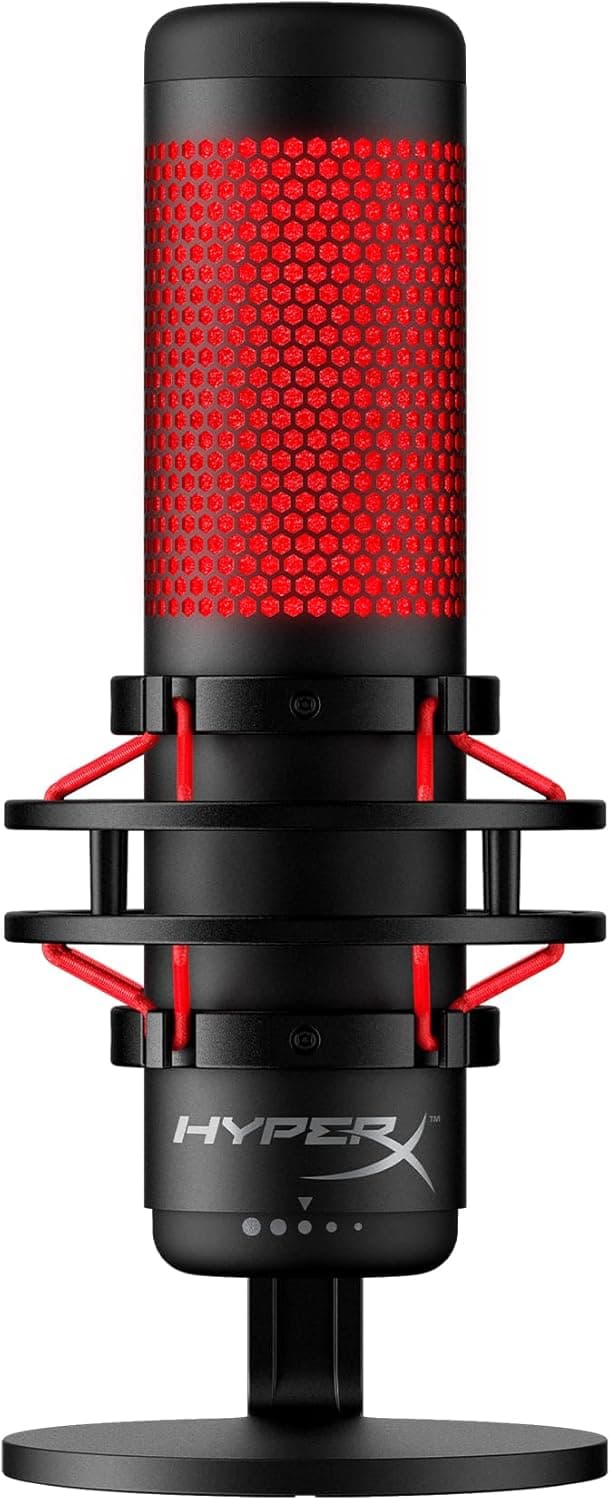
HyperX's QuadCast is a USB condenser with an anti-vibration shock mount, a gaming-styled mic that also handles solo podcasting.
Price range: See on Amazon
What we liked
- + Anti-vibration shock mount cuts thumps from desk bumps and keyboard hits
- + Several pickup patterns let you switch between solo talk and in-person guests
- + Tap-to-mute top and red glow make mute status easy to see mid-stream
Trade-offs
- - Condenser capsule picks up room echo, so speak close and treat the space
- - Proprietary mount shape makes swapping to other shock mounts awkward
Who the QuadCast suits
The QuadCast is built for someone who wants a single USB microphone that covers gaming, streaming, and podcasting without buying separate gear for each. Its four polar pattern options mean it can switch from a tight cardioid pickup for solo talking to an omnidirectional or bidirectional mode for a quick two-person interview recorded around one mic. That flexibility makes it a sensible pick for a creator whose content mixes podcast episodes with livestreams or voiceover work, though a podcaster recording with a co-host every episode will usually get cleaner separation from two dedicated mics than from one QuadCast switched to bidirectional mode.
Anti-vibration shock mount and mute control
The mic ships with a built-in anti-vibration shock mount rather than requiring a separate boom arm shock mount, which helps cut down on thumps transmitted through a desk from typing, mouse clicks, or accidental bumps. A tap-to-mute sensor on top of the mic glows red when muted, giving a fast, visible way to cut audio mid-recording without hunting for a software toggle. These two features are aimed squarely at live streaming, where a physical mute and vibration control matter in the moment, but they carry over well to podcast recording sessions where you want to avoid picking up desk noise or accidentally leaving the mic hot.
Four polar patterns explained
The QuadCast offers stereo, omnidirectional, cardioid, and bidirectional pickup patterns, selectable through a dial on the base of the mic, with a frequency response rated at 20 Hz to 20 kHz. Cardioid is the pattern most podcasters will use most often, since it favors the voice directly in front of the capsule and reduces pickup from the sides and rear. The other three patterns exist for specific situations, such as recording a room in stereo for ambience or capturing two people seated across from each other in bidirectional mode, giving the mic more use cases than a fixed-pattern microphone at a similar price.
Condenser sensitivity and room noise
Being a condenser rather than a dynamic mic, the QuadCast is more sensitive overall, which means it captures more detail from a voice but also picks up more of the room around it, including HVAC hum, computer fan noise, and echo off bare walls. Speaking close to the capsule and adding basic sound treatment nearby will noticeably improve recordings in an untreated room, while using it across a large open space will highlight its sensitivity in a less flattering way. This tradeoff is standard for USB condensers in this price range and is worth planning for rather than a flaw unique to this microphone.
Mount compatibility and value
The included shock mount uses a proprietary connection, so swapping to a third-party shock mount or a different boom arm mount is less straightforward than with mics that use a standard thread, which is worth knowing if you already own studio arm hardware. Against other podcast microphones, the QuadCast holds up well on features and build for its price, backed by a two year warranty from HyperX, even though dedicated broadcast dynamic mics from Shure and RODE outscore it for raw podcasting focus and rejection of background noise. For a creator who wants one flexible USB mic across gaming, streaming, and podcasting, it remains a solid, well-rounded choice.
Frequently asked questions
Does the HyperX QuadCast need an audio interface?
No, it connects over USB and works as a plug-and-play microphone with your computer, without needing a separate interface or phantom power.
How many polar patterns does the QuadCast have?
Four: stereo, omnidirectional, cardioid, and bidirectional, selectable through a dial on the base of the microphone.
Does the QuadCast come with a boom arm?
No, the microphone boom arm is not included; it ships with the microphone, a USB cable, a mount adapter, and a quick start guide.
Is the QuadCast good for two people recording on one mic?
Its bidirectional pattern can capture two people facing each other across the mic, though separate microphones per person generally give cleaner, easier to edit audio.
Prices change often, so check the current price and availability on Amazon.
Check price on AmazonPodcast Gear Hub may earn a commission from the link above.